In a global economy, disputes rarely remain confined to one jurisdiction. International arbitration has therefore become one of the preferred mechanisms for resolving cross-border disputes. A dispute is “international” where it contains a foreign element, for example because the parties are based in different states, performance or assets are located abroad, or the arbitration has a seat outside one party’s home jurisdiction. Arbitration is today the preferred method for resolving international disputes, particularly because users value flexibility, specialist decision-makers, efficiency and enforceability. In that sense, arbitration can even be understood as a controlled privatisation of justice: the merits are decided by privately appointed arbitrators under agreed rules, while state courts continue to play an essential role in judicial assistance, limited review and enforcement.
What are the main advantages of international arbitration?
The single most important advantage of international arbitration is the worldwide enforceability of arbitral awards. Thanks to the 1958 New York Convention, arbitral awards benefit from a dedicated international recognition and enforcement framework across 172 contracting states. That is one of the decisive reasons why arbitration is so attractive in cross-border business: arbitral awards travel internationally under a treaty regime that court judgments generally do not enjoy on a comparably global scale.
Arbitration also gives parties a level of procedural control that ordinary court litigation rarely offers. The parties may choose arbitrators with sector-specific expertise, determine the number of arbitrators, select the seat, the language and the applicable law, and adopt procedural rules suited to the transaction and the dispute. Swiss arbitration law strongly protects that party autonomy: Chapter 12 PILA allows, for instance, parties broad freedom to shape the procedure, confirms the tribunal’s power to rule on its own jurisdiction, and provides for interim measures and judicial assistance where necessary. The result is a dispute-resolution mechanism that is not only enforceable, but also expert-driven, neutral and commercially practical.
What are the main types of international arbitration?
In practice, three categories are especially important. First, international commercial arbitration concerns disputes between private parties, for example arising out of sale of goods, joint ventures, shareholders’ agreements, construction projects, financing arrangements or long-term supply contracts. These disputes may be administered institutionally, for example under the ICC Rules or the Swiss Rules, or they may proceed on an ad hoc basis, often under the UNCITRAL Arbitration Rules.
Second, investment arbitration typically concerns disputes between a foreign investor and a host state, often under bilateral investment treaties, multilateral treaties, investment legislation or investment contracts. A central institution in this field is ICSID, which was established by the ICSID Convention within the World Bank framework. One of the key features of the ICSID system is enforcement: pecuniary obligations in an ICSID award must be recognised and enforced by each contracting state as if the award were a final judgment of that state’s own courts.
Third, sports arbitration has a uniquely Swiss centre of gravity. The Court of Arbitration for Sport (CAS), seated in Lausanne, is the globally recognised specialist institution for sports disputes. Under the CAS Code, in particular Articles R27 and R28, CAS jurisdiction exists where the parties have agreed to submit a sports-related dispute to CAS or where the statutes or regulations of a sports body provide for CAS, and the seat of CAS panels is Lausanne, Switzerland.

What are the key institutions, laws and bodies in Switzerland?
For international arbitration seated in Switzerland, the starting point is Chapter 12 of the Swiss Private International Law Act (PILA), namely Articles 176 to 194. As a matter of scope, Chapter 12 applies where the seat of arbitration is in Switzerland and at least one party had neither domicile, habitual residence nor business establishment in Switzerland when the arbitration agreement was concluded. Domestic arbitration is regulated separately in Part 3 of the Swiss Civil Procedure Code.
Within Chapter 12, several provisions are especially important in practice. Article 182 protects party autonomy over procedure. Articles 183 to 185 deal with interim measures, taking of evidence and judicial assistance. Article 186 codifies competence-competence. Article 187 allows the tribunal to decide the case under the rules of law chosen by the parties. Article 190 limits challenges to awards to narrowly defined grounds. Article 191 channels such challenges to the Swiss Federal Supreme Court. Article 194 confirms that the recognition and enforcement of foreign awards in Switzerland are governed by the New York Convention. Switzerland is also notably arbitration-friendly at the set-aside stage, because written submissions to the Swiss Federal Supreme Court in international arbitration matters may be filed in English.
On the institutional side, the Swiss Arbitration Centre is the leading commercial arbitration institution in Switzerland and administers proceedings under the Swiss Rules of International Arbitration, which are expressly designed to be efficient, flexible and cost-effective. The former Swiss Chambers’ Arbitration Institution was converted into the Swiss Arbitration Centre in 2021. Beyond commercial arbitration, Switzerland also hosts globally recognised specialist bodies, above all CAS in Lausanne for sports disputes and the WIPO Arbitration and Mediation Center in Geneva for IP and technology disputes.
Why choose Swiss law as the applicable law?
Swiss law is frequently chosen in international contracts because it is clear, codified, predictable and commercially pragmatic (Swiss Contract and Obligation Laws | ASA). It is a mature civil-law system, not a common-law system, but international users value it because the statutory texts are accessible, available in several languages and built around legal certainty. Two features are especially attractive in cross-border contracting: Swiss contract law gives parties broad freedom to shape their agreement within the limits of the law, and Swiss private law is anchored in the overarching principle of good faith. That combination of autonomy, predictability and neutrality is one of the reasons why Swiss law has long enjoyed an excellent international reputation.
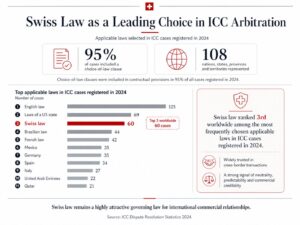
Market practice confirms that this is not merely a doctrinal preference. In ICC arbitrations filed in 2024, Swiss law was among the most frequently chosen governing laws worldwide. That says a great deal about how international counterparties perceive Swiss law: as balanced, reliable and well suited to sophisticated commercial relationships. For many parties, choosing Swiss law is therefore not simply a legal decision, but a strategic one.
Why choose Switzerland as the arbitration forum?
Switzerland offers precisely the qualities that international users seek in an arbitral seat: neutrality, political and economic stability, a secure and modern legal framework, excellent infrastructure, and a multilingual arbitration community with deep experience in complex cross-border disputes. Chapter 12 PILA is deliberately arbitration-friendly and gives parties wide autonomy, while judicial review is concentrated before the Swiss Federal Supreme Court on limited statutory grounds only. That combination creates a seat that is both legally dependable and operationally efficient.
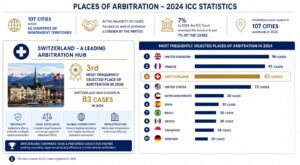
The statistics are equally telling. In ICC cases for 2024, Switzerland was among the most frequently selected places of arbitration in the world, and both Geneva and Zurich ranked among the leading arbitral cities. That standing is not accidental. Parties choose Switzerland because it combines neutrality with quality: experienced arbitrators and counsel, institutional depth, high judicial reliability, and specialist know-how in fields where Switzerland has genuine international prominence, including sports and IP-related disputes.
Conclusion
International arbitration is no longer a niche mechanism. It is one of the most important tools for resolving international disputes, and Switzerland remains one of its most credible and attractive centres because it combines enforceability, neutrality, flexibility, institutional quality and a modern legal framework.
When drafting cross-border contracts, the choice of Swiss law and a Swiss seat can be a powerful strategic decision. When a dispute has already escalated, Swiss arbitration offers a reliable forum in which complex international cases can be resolved efficiently and credibly. We advise clients on the drafting of arbitration clauses, the selection of Swiss law and Swiss arbitral seats, the conduct of arbitral proceedings in Switzerland, interim measures, set-aside proceedings and the enforcement of awards. We would be pleased to support you in this area of law.
Disclaimer
This Insight is intended for general information purposes only and does not constitute legal advice. For legal advice on your specific situation, please contact us directly.